
ショッピングとタイアップでは、効き方が違う
Rethinking Commerciality: How Content Commerciality Contributes to YouTube Beauty Content Performance
Jaeyoung Park · Sewon Eom · Eugene Choi · パク・ジノ · Seongcheol Kim* * 責任著者
「広告に見えると損」と決めつけてよいのでしょうか。公式要旨は、そう単色には書いていません。コンテンツ経由で商品を売る動画はタイアップより反応が高く、直前の収益はむしろ低い。高麗大学の研究チームとパク・ジノ代表の共著が、2026年4月14日、JTAERにオープンアクセスで掲載されました。
書誌情報
- 原題
- Rethinking Commerciality: How Content Commerciality Contributes to YouTube Beauty Content Performance
- 学術誌
- Journal of Theoretical and Applied Electronic Commerce Research 21(4), 118
- 掲載
- 2026-04-14
- DOI
- https://doi.org/10.3390/jtaer21040118
- オープンアクセス本文
- https://www.mdpi.com/0718-1876/21/4/118
- 公式PDF(出版社リンク)
- https://www.mdpi.com/0718-1876/21/4/118/pdf — 著作権のため、本サイトにはPDFファイルを置いていません。
- 所属の記載
- (1) College of Media and Communication, Korea University, 145 Anam-ro, Seongbuk-gu, Seoul 02841, Republic of Korea (2) Beaus Company Co., Ltd., 12F, Kyungwon bld, 340, Gangnam-daero, Gangnam-gu, Seoul 06242, Republic of Korea
公式アブストラクト(英語)
以下はMDPIの誌面に公開されている公式アブストラクトです。本論文はオープンアクセス(CC BY)です。本文と公式PDFは出版社のリンクでご覧ください。本サイトにはPDFファイルを置いていません。
Creative expression is no longer separate from monetization. It is increasingly structured by the business models that platforms provide. Content monetization has evolved rapidly: early models focused on advertising revenue, followed by brand partnerships, and most recently, the integration of commerce-oriented features at the platform level. YouTube, for example, launched its YouTube Shopping service in South Korea in June 2024, enabling creators to sell products directly through their content. This development demonstrates that commerciality has become intrinsic to the creator economy. While prior research has emphasized factors such as authenticity, less focus has been placed on commerciality itself. This study addresses this gap by analyzing how varying levels of content commerciality affect performance, using real-world data from a Korean YouTube beauty creator agency (N = 286 short-form videos). The analysis tests the effects of three revenue models (organic, sponsored, and content-driven commerce) and two content types (context-focused and product-focused) through multiple regression. Results reveal a trade-off between engagement and revenue, as while content-driven commerce generates significantly higher engagement than sponsored content, it yields lower immediate revenue. Regarding content strategy, contrary to expectations, product-focused content consistently outperforms context-focused content in driving engagement, except within sponsored videos where a context-focused approach effectively mitigates the negative impact of overt commercial intent. These findings demonstrate the divergent efficacy of monetization models and content strategies in the short-form ecosystem. By empirically validating the relationship between commerciality and performance, this study advances theoretical discussions on the platform-driven creator economy and offers practical insights for creators, brands, and platforms navigating this evolving environment.
先に結論を
商業性は、もうコンテンツの外側の話ではありません。要旨は、2024年6月にYouTubeショッピングが韓国で始まったことを例に挙げます。表現と収益化が同じ画面で動きます。
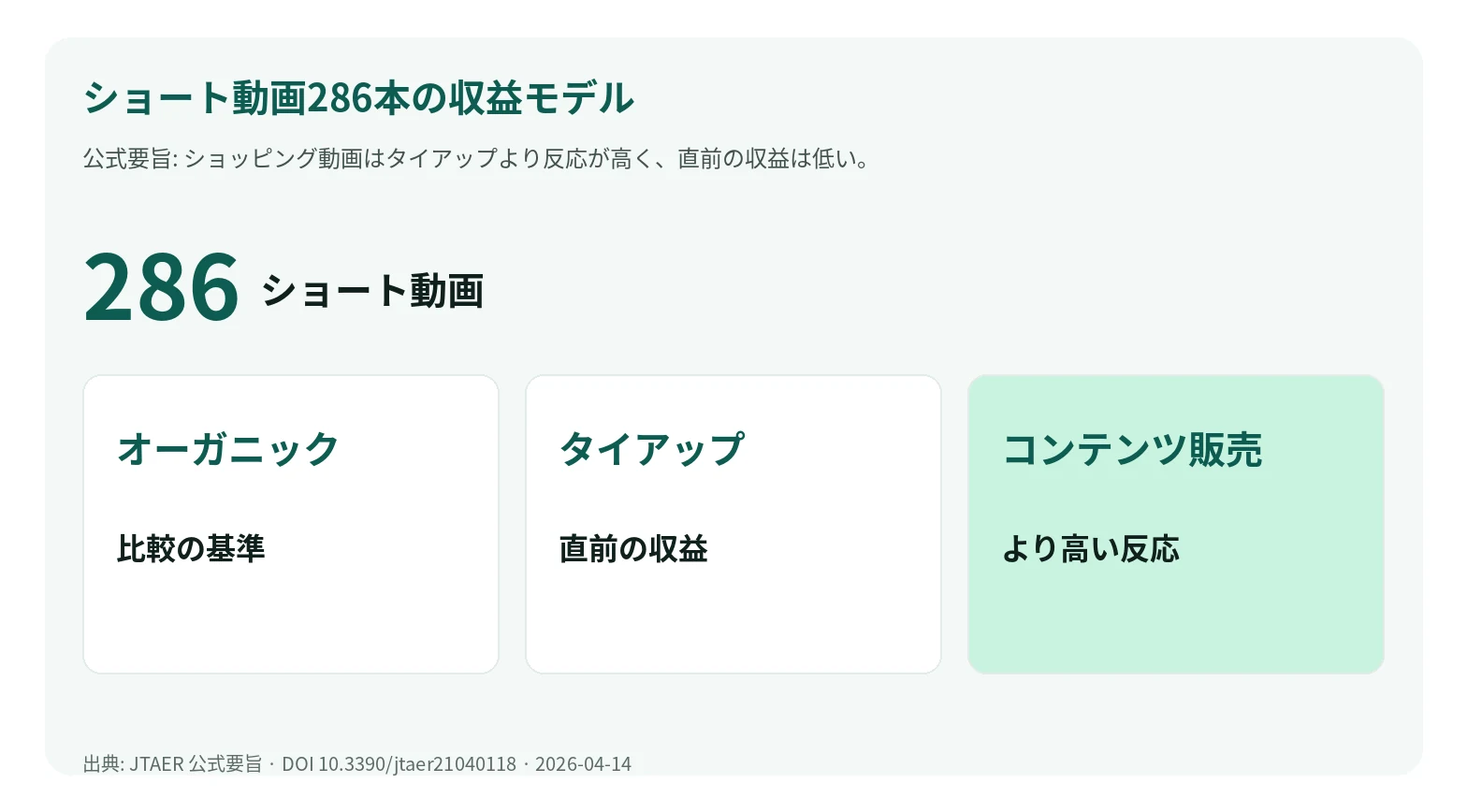
286本のショートを、オーガニック、タイアップ、コンテンツ起点の販売の三モデルと、文脈型・商品型の二類型で見た重回帰です。ショッピング動画はタイアップより有意に反応が高く、直前の収益は低い。商品がはっきり見える動画のほうが概して反応を集め、例外はタイアップでした。タイアップでは、文脈のある話が「広告感」のマイナスを和らげました。
何を見たのか
データは、韓国の美容クリエイター事務所の実際のショート286本です。公式要旨が示す範囲は、そこに限ります。
先行研究がオーセンティシティに寄っていたところへ、この論文は商業性そのものを変数にしています。日本のインフルエンサー案件でも、「タイアップに見えると伸びない」という感覚を、反応と直前の売上に分けて検証した形です。
日本の担当者として読むなら
タイアップとショッピングを一つの「広告動画」にまとめると、企画がぶれます。タイアップは物語の文脈を残して広告感を下げ、ショッピングは商品がすぐ見えるように分けるほうが、この結果には沿います。
本文はオープンアクセスです。解説より先に、出版社ページの論文と公式PDFをご覧ください。ファイル自体は本サイトに置いていません。
このページはビューズカンパニーによる解説です。公式の文言と数値は学術誌ページと上記の要旨に従います。図は要旨が述べた方向のみを示し、係数は入れていません。